
Payout Smoothing: Why the Same Hash Feels Different Every Month
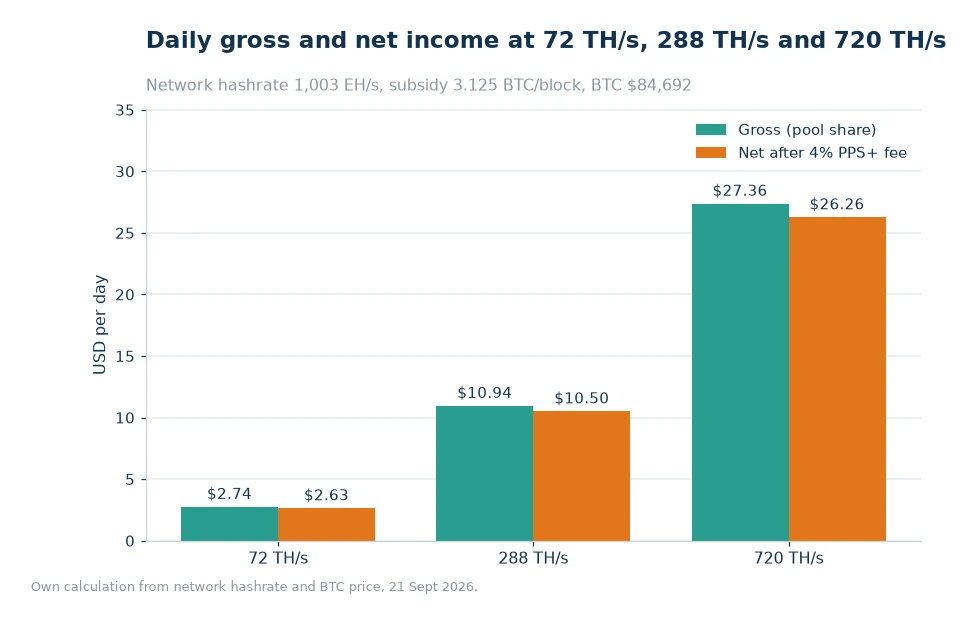
Two miners can run identical hardware on the same pool and still describe their income very differently, because the shape of a payout matters as much as its size. At 72 TH/s the formula returns 3.23e-05 BTC a day, $2.74 at $84,692 per BTC and $2.63 after the listed 4% on the block-reward component. At 720 TH/s the same day is worth 0.000323 BTC and $27.36 gross, but it arrives in hourly slices of roughly 1.35e-05 BTC rather than in one lump.

Key takeaways
- 72 TH/s produces 3.23e-05 BTC a day, or about 1.35e-06 BTC every hour under hourly settlement.
- PPS+ converts variance into a listed cost of 4% on the block-reward component; PPLNS leaves the variance with the miner at a listed 2%.
- The 72 to 720 TH/s range spans exactly ten times the output, from $2.74 to $27.36 gross per day.
- A 2.12% difficulty decline lifts revenue per terahash by about 2.17%, which is worth more than most fee comparisons.
Three shapes of the same income
Solo mining pays in rare lumps. A small machine on a solo setup can run for months between blocks, and the expected time to find one at 72 TH/s is measured in centuries rather than weeks. Pool mining with PPLNS pays per block, so income arrives when the pool finds blocks, which is frequent but uneven. Pool mining with PPS+ pays per hour against current difficulty, which turns the same average into a near-flat line.
The average is not better in any of the three. What changes is when the money shows up and who absorbs the deviation from the average. For an operator paying a power bill on the tenth of the month, a flat line is worth paying for. For an operator with a long horizon and spare cash, the lower listed rate on PPLNS can be the better trade.
Why smoothing has a price and a value
The price is printed on the schedule: 4% on the block-reward component under PPS+ against 2% on the combined total under PPLNS. The value is harder to see and easier to feel. A payout that arrives every hour can be moved, spent, converted or left alone without guessing what the month will bring. A payout that depends on block luck requires a buffer, and a buffer is capital that is not doing anything else.
Small operators usually underprice that buffer. If a PPLNS month lands 30% below expectation and the power bill does not move, the shortfall has to come from somewhere. Put a number on that: at 288 TH/s a 30% shortfall on $10.50 net is $3.15 a day, or $94.50 across a month. Holding that much cash against the possibility is a real cost, and it belongs in the comparison next to the fee difference.
Hourly credits change the planning unit
Once settlement is hourly, the natural planning unit becomes the day and the natural check becomes the hour. That is a better rhythm than a monthly total, because a machine that fails on the third of the month shows up in the hourly series immediately. It also makes tests cheap: change a fan curve, watch two hours of credits, and you know whether the change helped.
| Hashrate | BTC per day | BTC per hour | Gross per day | Net per day |
|---|---|---|---|---|
| 72 TH/s | 0.00003230 | 0.00000135 | $2.74 | $2.63 |
| 288 TH/s | 0.00012921 | 0.00000538 | $10.94 | $10.50 |
| 720 TH/s | 0.00032300 | 0.00001346 | $27.36 | $26.26 |
The hourly column is the one to write on the whiteboard. It is small enough to be uninteresting, which is the point: a steady drip of 1.35e-06 BTC an hour at 72 TH/s is easier to verify than a monthly total, and a missed hour stands out against its neighbours.
Worked example
Start at 72 TH/s, build the day, then scale to the other two bands.
- Network share: 72 divided by 1,003,000,000 TH/s equals 7.178e-08.
- Daily coins: 7.178e-08 multiplied by 450 BTC equals 3.23e-05 BTC.
- Gross value: 3.23e-05 multiplied by $84,692 equals $2.74.
- Listed fee: 4% of $2.74 is $0.11, leaving $2.63 net.
- Hourly credit: 3.23e-05 divided by 24 equals 1.35e-06 BTC.
- Four times the hash at 288 TH/s: 0.00012921 BTC, $10.94 gross, $10.50 net, 5.38e-06 BTC an hour.
- Ten times the hash at 720 TH/s: 0.000323 BTC, $27.36 gross, $1.09 of listed fee, $26.26 net, 1.35e-05 BTC an hour.
- Thirty days at 720 TH/s: $820.80 gross and $787.80 net, before power and before any difficulty change.
Modelling the next difficulty change
Difficulty is estimated to fall 2.12% at the next adjustment, read on 21 Sept 2026. Because daily issuance is fixed at 450 BTC and difficulty tracks network hashrate, a decline of that size raises output per terahash by about 2.17%, the reciprocal of 0.9788. On 720 TH/s that turns $27.36 into roughly $27.95 gross a day, an extra $0.59 that arrives without any change to the hardware.
Now reverse it. A 2.12% rise would take the same position down by about 2.07%, or $0.57 a day. Changes of this size happen every two weeks, which is why a monthly forecast built on one difficulty reading is already out of date by the time it is typed. Treat the estimate as a direction, not a destination, and update the model when the adjustment lands.
This is also where a pool's reporting earns its keep. If difficulty moves and your credited BTC does not move in the same direction within a day, the gap is worth investigating. The pool's network statistics page and your own payout history should tell the same story.
Building a month that survives a bad week
Three habits make the smoothing argument concrete. First, keep a week of hourly credits before deciding whether a machine is performing; one day is not a sample. Second, convert the daily net figure to both BTC and dollars, because a fall in price and a rise in difficulty look identical in a dollar column and different in a coin column. Third, decide in advance what a 20% shortfall would mean for the power bill.
That last point is where payment method becomes a cash-flow decision rather than a fee debate. PPS+ is the default for a reason: it removes the timing risk that most small operators are least equipped to absorb. PPLNS remains available, and it is a reasonable choice for a miner who already holds a buffer and prefers the lower listed rate on the combined total.
For operators running a mixed fleet across BTC, LTC with DOGE merged mining, KAS and the rest of the supported list, a single account for ViaBTC Crypto Mining keeps the hourly series in one place instead of one dashboard per chain. That matters more as the number of coins grows, because the comparison only works when the credits share a timestamp.
Frequently asked questions
Is a smoother payout worth a higher listed rate?
It depends on the buffer you already hold. The listed difference is 4% against 2% on the block-reward component, which at 288 TH/s is roughly $0.44 a day, and that is the price of not carrying block-timing risk.
How many hourly credits should I watch before judging performance?
A full week, or 168 credits, gives a usable baseline. A single day can be distorted by a restart, a fan event or a difficulty change.
Does a difficulty decline change my fee percentage?
No. The listed rate stays where it is; what changes is the number of coins the same hash produces, and therefore the dollars the rate applies to.
Pick the shape you can actually run
Write down the daily net figure for your own hashrate, divide it by 24, and check that the hourly number appears in your account. Then ask whether a month 20% below that figure would be an inconvenience or a problem. The answer decides the payment method more reliably than any comparison of headline percentages.
Sources: published fee schedule and settlement terms[1], with chain inputs read 21 Sept 2026: network hashrate about 1,003 EH/s, difficulty 132.76 T, subsidy 3.125 BTC per block over 144 blocks a day, BTC at $84,692, and a next-adjustment estimate of -2.12%. Figures read 21 Sept 2026, published 22 Oct 2026. Dollar amounts are arithmetic on those inputs, not a forecast of returns.