
Why are mining screen panels important for ore processing?
Mining screen panels act as the primary sizing regulators in mineral processing, directly determining the recovery rate of valuable metals like copper or gold. In high-volume operations processing 2,500 tons per hour, achieving a 95% screening efficiency ensures that downstream ball mills only receive material requiring further reduction, preventing energy waste. By utilizing polyurethane or rubber panels, facilities can extend the wear life to over 3,000 operational hours, maintaining a constant aperture tolerance of ±0.2mm. This precision eliminates the carry-over of fines, which can otherwise lower flotation recovery by 0.8% to 1.5% per cycle.
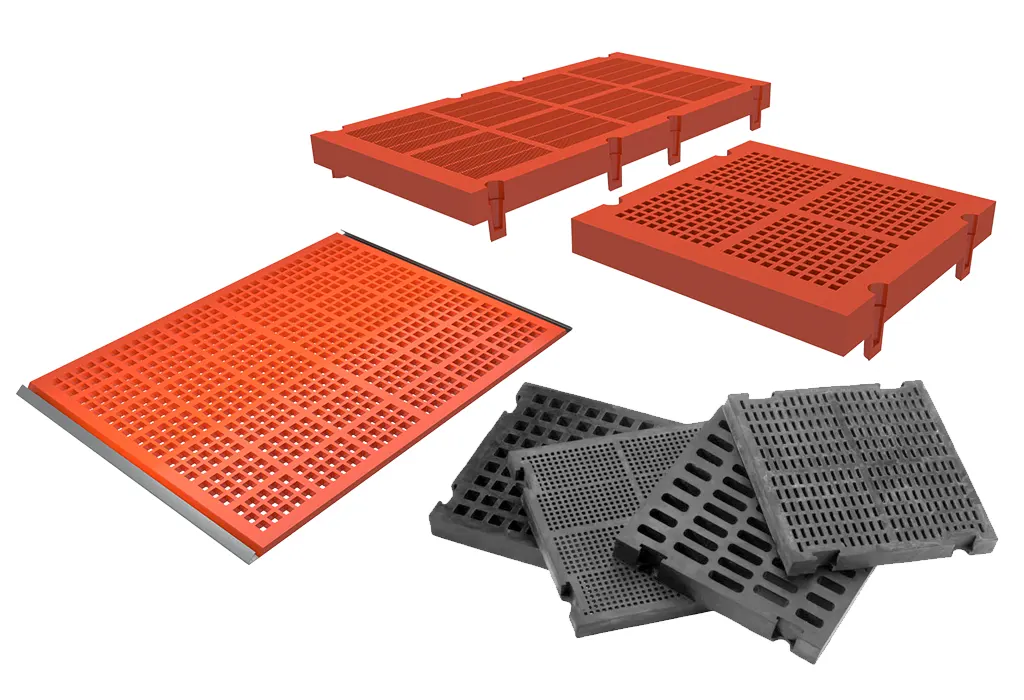
The mechanical separation of raw ore requires a surface that can withstand constant abrasion and high-velocity impacts while maintaining a consistent throughput rate. Mining screen panels provide this structural stability by using advanced polymer chemistry or high-tensile steel to resist the physical degradation caused by silica-heavy ores.
When a plant manages a recirculating load, the ability of the screen to pass undersized particles on the first attempt defines the total energy balance of the site. Industrial data from 2024 shows that improving the first-pass efficiency by 7% reduces the secondary crusher’s power draw by roughly 1.2 kWh per ton.
"A well-optimized screen deck acts as a flow regulator; if the panels fail to clear fines at the design rate, every downstream pump and mill operates outside its engineered performance curve, leading to a 10% increase in operational costs."
The transition from traditional steel to synthetic media has allowed operators to handle higher moisture contents, which often fluctuate between 4% and 11% in open-pit mining operations. Polyurethane panels with internal reinforcement remain flexible enough to vibrate independently, which prevents the "caking" of wet fines that typically blocks static steel surfaces.
This self-cleaning behavior is supported by the tapered design of the apertures, where the opening at the bottom is slightly wider than at the top. This geometry ensures that a particle that enters the opening will pass through completely rather than becoming "pegged," a condition that can block 25% of the active area in under an hour.
| Feature | Steel Woven Mesh | Polyurethane Modular | Rubber High-Impact |
| Wear Life (Hours) | 150 - 450 | 2,000 - 4,500 | 1,800 - 3,500 |
| Noise Reduction | 0 dB (Base) | -6 to -10 dB | -12 to -15 dB |
| Impact Limit | Medium | Medium-High | Maximum |
The durability of these surfaces is a major factor in reducing the "cost per ton," as every unplanned maintenance stop involves both labor and lost revenue. In a study of 60 copper processing circuits in 2025, modular panels allowed maintenance crews to replace only high-wear zones in 30 minutes, compared to 4 hours for a full mesh replacement.
By localizing the replacement of worn sections, mining companies can reduce their spare parts consumption by 35% to 50% over a single fiscal year. This modularity ensures that the high-impact zone directly under the feed box is reinforced with thicker rubber, while the discharge end uses thinner, high-open-area polyurethane for final sizing.
"Maintaining a consistent aperture size is the only way to stabilize the chemical recovery process; if panels wear out and allow oversized rock into the leaching tanks, the extraction efficiency of the reagents drops by 2% to 4%."
The loss of chemical efficiency is often more expensive than the hardware itself, as it represents a permanent loss of mineral value that cannot be recovered later. For this reason, modern plants use digital sensors to monitor the wear depth of the panels, scheduling replacements exactly when the aperture exceeds a 1.5mm wear threshold.
Using synthetic panels also reduces the overall weight of the screen deck by up to 600 kilograms in large-scale vibrating units. This reduction in "dead weight" allows the vibration motor to maintain a higher stroke and a constant frequency of 850 RPM without overheating the drive bearings or causing structural fatigue in the side plates.
| Performance Indicator | Old Steel System | Modern Modular Panels | Improvement |
| Daily Throughput | 18,000 Tons | 22,500 Tons | +25% |
| Bearing Life | 4,000 Hours | 6,500 Hours | +62.5% |
| Product Precision | 88% | 98.5% | +10.5% |
The improvement in bearing life and structural integrity further lowers the total maintenance budget, as the screen box itself experiences fewer stress-related cracks. This mechanical synergy ensures that the plant remains available for 92% to 96% of the calendar year, providing the consistent output needed to meet contract obligations and market demand.
In heavy-duty gold or iron ore processing, the panels must also handle "near-size" particles that match the aperture diameter almost exactly. Advanced synthetic designs use "flip-flow" or high-resilience membranes that toss these particles back into the material bed, preventing the screen from becoming a solid floor of trapped rocks.
"A plant processing iron ore at a rate of 1,200 tons per hour found that using high-resilience panels maintained a constant 82% open area throughout a 12-hour shift, preventing the 15% drop in tonnage seen with rigid steel."
This stable performance through the shift is necessary for the automated control systems that manage the water and reagent balance in the downstream flotation cells. When the feed rate is predictable and the particle size is uniform, the automation software can optimize the recovery parameters with a 99% confidence interval.
The use of stainless steel or specialized alloy reinforcements within the polyurethane ensures that the panels do not sag or bow under the weight of the material bed. Sagging causes material to pool in the center of the screen, which creates a "blanket effect" that prevents fines from reaching the sizing surface, effectively cutting the screening area by half.
The choice of panel configuration—whether it is a snap-fit, bolt-down, or pin-and-sleeve system—affects the ease of installation during short maintenance windows. In a 2024 test trial, snap-fit systems were installed 3 times faster than traditional bolt-down versions, allowing the plant to return to production ahead of schedule and capturing an additional $12,000 in hourly revenue.
These incremental gains in time and efficiency are what differentiate a profitable mining operation from one that struggles with overhead costs. By focusing on the material science of the screening surface, operators can ensure that every ton of raw ore is processed at the lowest possible cost while maximizing the recovery of the minerals contained within.
The long-term strategy for any ore processing facility should include a data-driven approach to screen media, where the material type and aperture geometry are adjusted based on the specific hardness and moisture of the ore body. This adaptability ensures that the plant can handle geological variations over the 10 to 20-year lifespan of the mine without requiring a complete redesign of the screening infrastructure.
The daily read for people who actually use the tech.
Hands-on reviews, teardowns, and first-look reporting delivered to your inbox every weekday morning.