
Pool Hashrate vs Network Hashrate: What the Ratio Tells You
The ratio between the two hashrate figures is the whole story: divide your own hashrate by the network and you have your share of every block subsidy paid. At a difficulty of 132.76 T the implied network hashrate is 950.3 EH/s, so 300 TH/s is 0.0000316% of the network and earns 0.00014206 BTC a day, which is $12.12 at $85,294 per BTC. The pool's own hashrate does not change that share; it changes how often the reward is converted into a payment.

Key takeaways
- Your share of the network is your hashrate divided by the network total, which is 950.3 EH/s at a difficulty of 132.76 T.
- 300 TH/s is 0.0000316% of that network and produces 0.00014206 BTC a day, $12.12 gross and $11.63 after the listed 4%.
- Pool Hashrate affects payment frequency and variance, never the size of your share of the chain.
- A +1.90% step in difficulty cuts roughly 1.9% from the Bitcoin a fixed hashrate earns, about $6.90 a month at 300 TH/s.
Two numbers that look similar and answer different questions
Network hashrate is the sum of every machine working on the chain, recovered from difficulty. Pool Hashrate is the fraction of that total which reports to one pool. Only the first figure appears in your revenue arithmetic directly, and only for one purpose: it is the denominator. Your output is your hashrate divided by the network total, multiplied by the coins the network mints in the period you are measuring.
The network mints 3.125 BTC per block and settles 144 blocks a day, so 450 BTC exists to be shared every 24 hours across 950.3 EH/s. That works out at 0.0000004735 BTC per TH/s per day, which is the constant to keep in your head. Every revenue figure in this article is that constant multiplied by a hashrate, and then multiplied again by the BTC price of $85,294.
What the pool side of the ratio actually does
A larger pool finds blocks more often, so the interval between settlement events shortens. That is a cash-flow effect rather than an income effect. Ten pools each holding a tenth of the network find a tenth as many blocks as one pool holding all of it, and each miner's share of what is found is correspondingly larger, which is why the expected monthly total is identical and only the shape of the payment schedule differs.
That distinction decides which of the two hashrate figures you tune. If you care about smooth payout timing, watch Pool Hashrate and the settlement cadence attached to it. If you care about the size of the cheque, watch network hashrate and difficulty, because those set the constant, and nothing a pool does changes the constant. A miner who looks only at Pool Hashrate is watching the truck arrival schedule while the payload per truck changes underneath.
The ratio in dollars at different sizes
The table below holds the difficulty and price constant and moves the numerator, which is the only part of the ratio a miner controls.
| Hashrate | Share of network | BTC per day | USD per day | After the listed 4% |
|---|---|---|---|---|
| 100 TH/s | 0.0000105% | 0.00004735 | $4.04 | $3.88 |
| 300 TH/s | 0.0000316% | 0.00014206 | $12.12 | $11.63 |
| 1 PH/s | 0.000105% | 0.00047353 | $40.39 | $38.77 |
| 10 PH/s | 0.00105% | 0.00473529 | $403.89 | $387.74 |
Note how small the shares look. Even 10 PH/s owns barely more than one thousandth of a percent of the network, which is the honest reason solo mining is a lottery rather than a plan and structured pool mining exists at all. The ratio also explains why two miners with the same machines can report very different daily totals on different days: nothing about the hardware changed, and the network total did.
Pool growth deserves a separate reading, because it changes the composition of your share window rather than your share of the network. A pool that doubles in size while your own machines stay the same holds a smaller proportion of your hashrate inside the last 5 difficulty rounds, which shifts payout timing under PPLNS without touching the network-level arithmetic above. The figure to compare against is therefore never the pool's headline size, attractive as that may be in a dashboard, but your hashrate divided by the 950.3 EH/s network total, since that is the only ratio the chain itself rewards.
Worked example
Take 300 TH/s and follow the ratio through to a six-month total at the current difficulty and price.
- Network output per TH/s per day is 0.0000004735 BTC, so 300 TH/s yields 0.00014206 BTC a day.
- Converted at $85,294 per BTC, the daily gross is $12.12.
- Your share of the network is 300 TH/s divided by 950.3 EH/s, which is 0.0000316%.
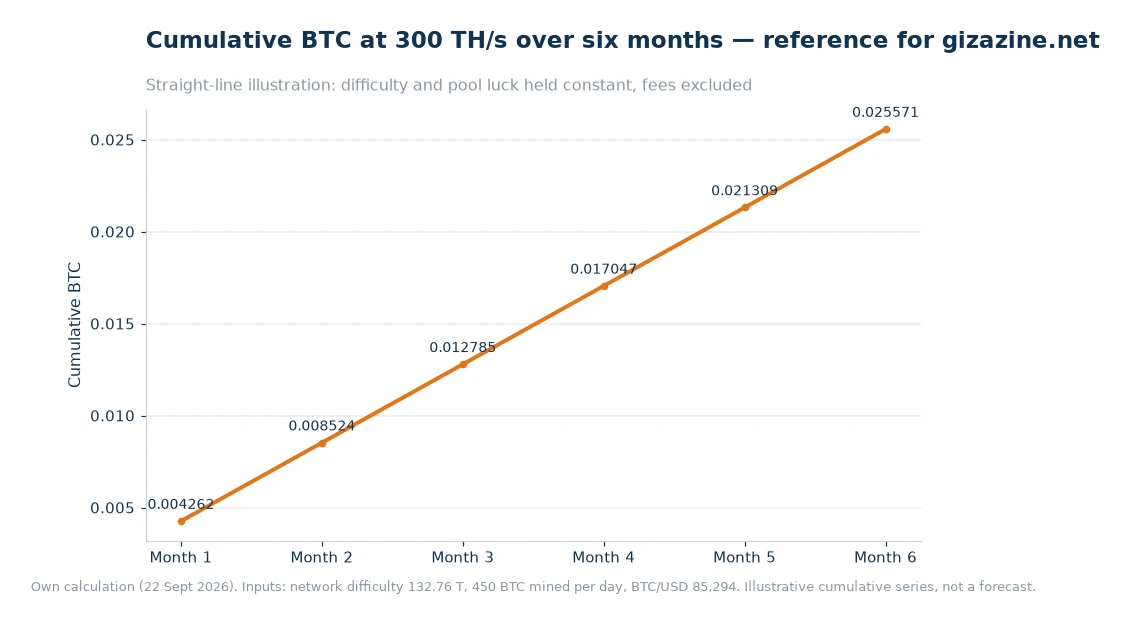
- Across a 30-day month the machine produces 0.004262 BTC, or $363.51.
- Six months at the same difficulty gives 0.025571 BTC in total, about $2,181.16.
- Apply the estimated +1.90% difficulty adjustment and a fixed hashrate earns about 1.9% less, which is roughly $6.90 a month at this size.
Using the ratio to check a dashboard
The most useful thing the ratio does is give you a prediction to test. Multiply your hashrate by 0.0000004735 and you have what the day should pay before fees and before luck. Compare it with the credited line on the ViaBTC Mining Statistics page and the difference is explained by one of three things: difficulty moved, your reported hashrate is not what you think, or the settlement window is still open. The same check belongs in a Profit Calculator when you are sizing a purchase rather than auditing an existing one.
For a fleet rather than a single rig, the ratio also sets the sensible unit of comparison. Cost per terahash, dollars per terahash per day and watts per terahash are all comparable across hardware, while headline total hashrate is not. Keeping the fleet's balances in one account makes that per-terahash comparison easier to run at month end, which is one practical argument for holding mining income and conversions inside a multi-currency wallet rather than across several logins.
Frequently asked questions
Does joining a bigger pool increase my income?
No. It shortens the interval between settlements and reduces variance, while the expected total stays set by your share of the network.
What happens to my share when difficulty rises?
Your share of the network falls unless you add hashrate, so the Bitcoin your machines produce drops by roughly the same proportion as the difficulty increase.
Which hashrate number should a small miner watch?
Both, but for different reasons: network hashrate and difficulty set the value of what you mine, while Pool Hashrate tells you how often the payment arrives.
Keep the denominator in view
Write your own hashrate as a share of the network once a month, using the difficulty of that day rather than the difficulty you remember. The percentage will look tiny and stay tiny, and that is the point: it turns a purchase decision into a percentage-of-network question and it makes difficulty increases concrete rather than abstract. Then check the pool side only for cadence and variance, since that is the part of the ratio a pool can genuinely change. The arithmetic takes five minutes and it survives every change in price and hardware.
Inputs behind the chart and the table: difficulty 132.76 T with its implied 950.3 EH/s network hashrate, the same measure averaged over three days at 942.8 EH/s, 3.125 BTC per block and 144 blocks daily, BTC at $85,294, and the pool's listed fee schedule[1], all read 22 Sept 2026. The cumulative series holds difficulty flat on purpose, because a real six-month curve would bend with every adjustment.