
Exterior-Glue Boards for Site Protection and Temporary Works
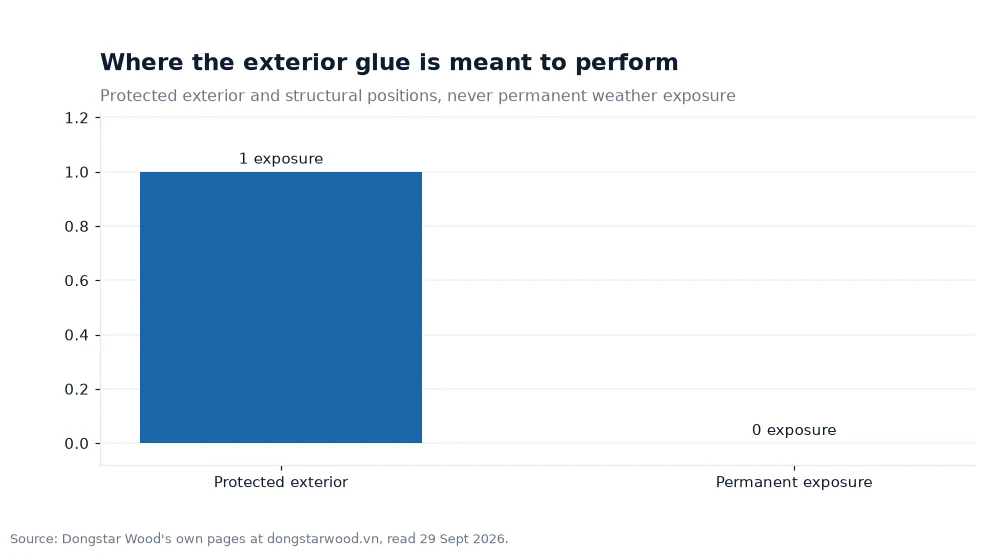
CDX is a specification, not a mystery: a C-grade face, a D-grade back and X — Exterior — glue. Dongstar Wood's construction-grade pine panel is built from pine veneers with a cross-laminated structure, resists moisture and rain during construction phases, and is aimed at the protected side of outdoor work rather than permanent weather exposure.

Key takeaways
- The name decoded: C-grade face, D-grade back, X (Exterior) glue.
- The moisture boundary: resists rain during construction; not designed for permanent exposure.
- The structure: pine veneers, cross-laminated to reduce warping and splitting under load.
- The site roles: roof decking, wall sheathing, subfloors, barriers, crating and temporary floors.
Decoding the CDX name
Every letter in CDX is a grade or a glue class. The C-grade face is the side that shows; the D-grade back is the side that does not; and the X stands for Exterior glue, the bond that holds the panel together when the weather turns. A buyer who can read the name can read the panel.
The decoding matters because it sets expectations honestly. This is construction-grade panel: the face is not furniture, the back is not meant to be seen, and the glue is the feature. A buyer who understands that stops asking the board to be something it was never built to be. The name also tells the buyer what not to ask for: a C-grade face will not take a clear finish the way a furniture panel will, and a D-grade back will never be seen — the grades are honest about the panel's role, and the honesty is what makes the specification usable.
The moisture boundary: what exterior glue does and does not do
The product page is explicit about the limit: the panel is not waterproof. The exterior glue resists moisture and rain during construction phases, but the board is best deployed where panels are not permanently exposed to weather. That single line captures the whole specification in miniature.
The boundary is a design tool, not a defect. A board that resists rain for the weeks a structure is open, and is then covered by the building envelope, is doing exactly the job it was built for. The buyer's responsibility is to keep the panel on the right side of that line — covered when the work is done, not left out for a season.
Pine veneers and the cross-laminated structure
The panel is made from pine veneers in a cross-laminated structure, and the page credits that structure with reducing warping and splitting under load. Cross-lamination is the reason a construction panel can be nailed, screwed and walked on without telegraphing every joint through the face.
Pine also sets the weight and the workability. A pine panel is lighter than a hardwood panel of the same thickness, which matters when the panel is being carried up a ladder or lifted onto a frame — the unglamorous half of site work that decides whether a board gets used the way it was intended. The cross-laminated build is also what lets the panel take fixings: nails and screws hold in a panel whose layers run in alternating directions, and a board that holds its fixings holds the frame — the unglamorous property that decides whether a temporary structure stays standing.
Site roles: decking, sheathing, subfloor and barriers
The product page lists temporary-works roles: roof decking and shingle and tile underlayment, exterior wall sheathing, subfloor and underlayment under carpet, laminate or vinyl, construction barriers and temporary structures such as hoarding, fencing and temporary floors, and crating and industrial packaging from heavy-duty crates to pallets.
Indoor use is common too — subfloors, wall bracing, structural frames — which is the clue that this is a panel for the inside of the construction cycle as much as the outside. The published CDX Pine Plywood range is the line a site planner draws most of its temporary panel from, in the thicknesses the frame requires. The crating and packaging end of the list is where the panel's working life often begins: a heavy-duty crate that protects a machine in transit has already done one job before it is cut down for hoarding or temporary flooring — the second life is planned at the purchase, not discovered afterwards.
Temporary works and the economics of the disposable panel
Temporary works have their own economics. A hoarding board or a temporary floor is bought for a project, not for a lifetime, and the value calculation is cost per week of service rather than cost per board. CDX sits at the economical end of that calculation: construction-grade pine, exterior glue, a price point that makes single-project use rational.
The same logic applies to crating and industrial packaging. A heavy-duty crate that ships a machine to site and then becomes scaffolding hoarding has done two jobs from one board — the kind of reuse that is planned at the purchase rather than discovered afterwards. The cost-per-week calculation is the buyer's half of the specification: a board that is covered when the work is done, stored flat and re-used across two projects costs less per week than a board that is left out for a season — the economics are a site habit as much as a panel property.
| Board element | Published detail | What it means on site |
|---|---|---|
| Face and back | C-grade face, D-grade back | Construction-grade appearance, honest limits |
| Glue | X — Exterior | Resists rain during construction phases |
| Structure | Cross-laminated pine veneers | Reduces warping and splitting under load |
| Exposure | Not designed for permanent weather | Covered by the envelope when work ends |
Worked example: planning a site's panel draw
Plan a site's panel draw from the format. A 1220 × 2440 mm board equals 1.22 m × 2.44 m, or 2.9768 m², and a hoarding run of 200 m² needs 200 ÷ 2.9768 ≈ 68 boards. With 100 × 40ft per month split across four weeks, that is 25 containers per week, and a site's temporary-works draw is a manageable share of output — the arithmetic that lets a contractor plan hoarding, barriers and crating from one order.
Frequently asked questions
What does CDX stand for?
C-grade face, D-grade back and X — Exterior glue. The name is the specification: a construction-grade face, an unseen back, and a bond that resists moisture and rain during construction phases.
Can CDX boards be left out in the weather?
No. The panel is not waterproof; the exterior glue resists moisture and rain during construction phases, but the board is best deployed where panels are not permanently exposed to weather. Plan to cover it with the building envelope when the work is done.
What are CDX boards used for?
The named applications are roof decking and underlayment, exterior wall sheathing, subfloor and underlayment, construction barriers and temporary structures such as hoarding, fencing and temporary floors, and crating and industrial packaging. Indoor use — subfloors, wall bracing, structural frames — is common.
Planning temporary works from the panel up
Temporary works reward the buyer who plans them as a system. Read the company's own profile to evaluate the operation behind the range, then look at the wire mesh film faced line to see how the same site serves the permanent formwork that outlasts a hoarding board. Buyers who plan the temporary and the permanent together tend to order once.
The data behind this article was taken from the mill's website consulted on 29 September 2026[1].